Great point. When I see those tip prompting screens, I remember to tell myself that they’re part of the point of sale software. To me, it’s just a feature included in the software. I feel it’s on me to take a beat to consider when a tip is appropriate and how much.
I vaguely recall being presented with tip screens in some wacky contexts too, like buying milk at a neighborhood market. Now I’m going to try to notice that more.
You obviously don’t know what is going on in California, e.g. tip pooling is very common in California (and legal) as long as it is in the line of service
I agree. It’s part of the POS software. I ignore and and feel no shame for choosing “no tip” in a retail establishment that doesn’t serve food they prepare there. Otherwise I tip 10% or 20% if I really like the place.
I don’t love our tipping culture but it is what it is. It’s easier for me to compute 20% on the total rather than to look at the pre-tax amount, calculate 20% on that and than add it to the total. And it’s a difference of what, $5 or so? I have a blanket policy of 20%, whether that’s for the kitchen or someone bringing me my food. Eating out to me is a privilege and I want to show my gratitude to the people providing food to me and my family, whether it’s in a pizza box or at a table.
It’s a curious thing but an establishment that has counter service for food without a tip jar (physical, or on the checkout screen) would seem to have to pay its employees minimum wage. If they put out the jar they gain the possibility of paying less.
Scenario 1: probably 0-10% depending on my mood. Would feel “comfortable” giving 0%, but as it’s a sit-down place, excellent chance I would give something.
Scenario 2: Not sure. Probably between 10% and 15% based on vibes.
Scenario 3: Again, 0-10% but way more likely to tip 0% here than in scenario 1. Seeing a 3% undisclosed add-on would guarantee a 0 tip.
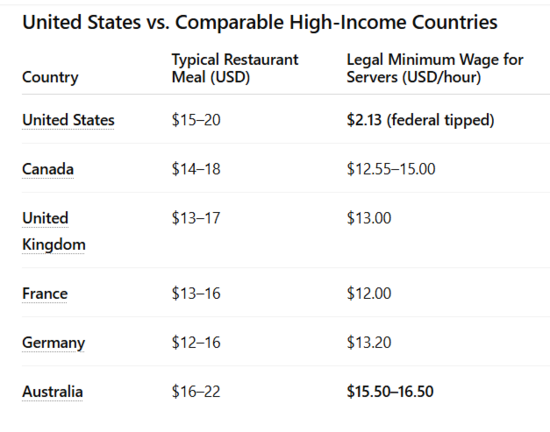
Is 40% tip enough? Article/opinion piece makes a point….it’s not on the customer to pay livable wages but the employer. Some how it’s been pushed off on the diner, and employer and government pretends it perfectly okay the way things are. BTW, $15/hr is no prize.
The customer will end up paying the livable wages one way or another. In the form of much higher restaurant prices with no tip model. US restaurants in general have thin profit margins. Do we want local independent restaurants to close? I don’t.
I don’t want mom and pop places to close. Margins are thin. But if you can’t pay people, including your family, should you be in business? I’m not sure any longer. It use to be immigrants and poor people opened restaurant to ensure a family would eat, using left over inventory to eat. While remembering something from home. But now over head is crazy, including new wage laws. The thing is, while new wage laws are there to protect workers, the rest of the restaurant industry and the long legacy of cheap labor and exploitation hasn’t changed. The whole tipping culture is based on the legacy of American slavery. High end restaurants don’t pay either in most cases…and some of these high end places run by restaurants groups have the balls to call for service fees instead of just adjusting prices. The only solution I can think of is kill the tip culture in the US, make everything transparent and pay people like in other countries…and do not make the job tip based. The examples are there in other countries. Why not just pay people?
And yet the average tipped waiter will tell you that they much prefer the current system of low hourly wages plus tips over the employer paying livable wages. Its easy to see why.
I agree, pay people. It’s part of the business expenses. The tipping culture is wrong on so many levels. But I think everyone needs to change at once. Those restaurants who end tipping, pay everyone themselves, need to increase menu prices. People will avoid restaurants with increased menu prices and go to those with lower menu prices and either tip or not tip. The big groups can afford it. Local independents have lower profit margins, especially if they have to pay rent, rent increases, and paid out hugely for liquor licenses. They’ll end up closing.
The entire business model has been in great need of change for a very long time.
Okay, please explain how this works. Do the low hourly wage plus tip employees have a livable wage model to compare to the tipped wage model? There’s not many of the no tip all serviced included places around. I know of only a few places that service gratuity is included and i seriously doubt those waitstaff want to go to a tipped model.
I can see how tipped employees at nice places might prefer pulling in $400 -$500 a night in cash tips. But it’s a shortsighted deal. Feels great but unless you’re extremely disciplined to put money away, you get shorted by not paying into social security in the long run. Also, being familiar with that lifestyle, $400 bucks in tips often turns into $100 bucks after you go get a drink, buy some blow and something to eat with colleagues.
Agree, the whole tipping culture has to change all at once to all inclusive, or you get stuck with tipping. Culture is very hard to break, even if there’s logic and reason to change, like paying employees fairly, and not being held to tipping culture. Several places in the Bay Area went all inclusive but switched back. One is a long standing success, Zuni Cafe. One place all inclusive works in Chez Panisse an their prices aren’t crazy but they own their own building. Downstairs waitstaff make a real living wage, 6 figures 20 years ago. So it can be done but i’m guessing restauranteurs made a good deal more with the old existing model. Not paying payroll taxes on tips is huge in itself.
Not giving an opinion on this, but thought I’d answer your question about “how this works”. One loses Social Security as you said. However, one may also declare very little and therefore qualify for other benefits, like Medicaid (which may be a better coverage than many employee health plans). And welfare. And Food Stamps. And Section 8 housing. And low income housing in general.
Again, no judgment being offered by me (at least, not here, with only virtual friends). Except, maybe to say that its not the only place that the underground economy thrives, especially in cities like Boston and NY.
The system works because over time they simply pocket more. For every 10 tables that pay the customary 20%, there will be a few that pay more, if not much more. And then there’s the occasional drunk that will pay their college tuition. The reason you see so few gratuity included places is because its very hard to pull off. Many tried and reverted back when not only they couldnt find employees that would agree but customers didnt like it either. Service included places often means 20-30% higher prices.
If tipped workers hated the current system, it would have been long gone.
And what SteveR said.
I think there’s confusion here between tip “pooling’ and tip ‘sharing’. Pooling is among service staff. Sharing refers to management taking a ‘share’, which is illegal in California.