looks fantastic
1 Like
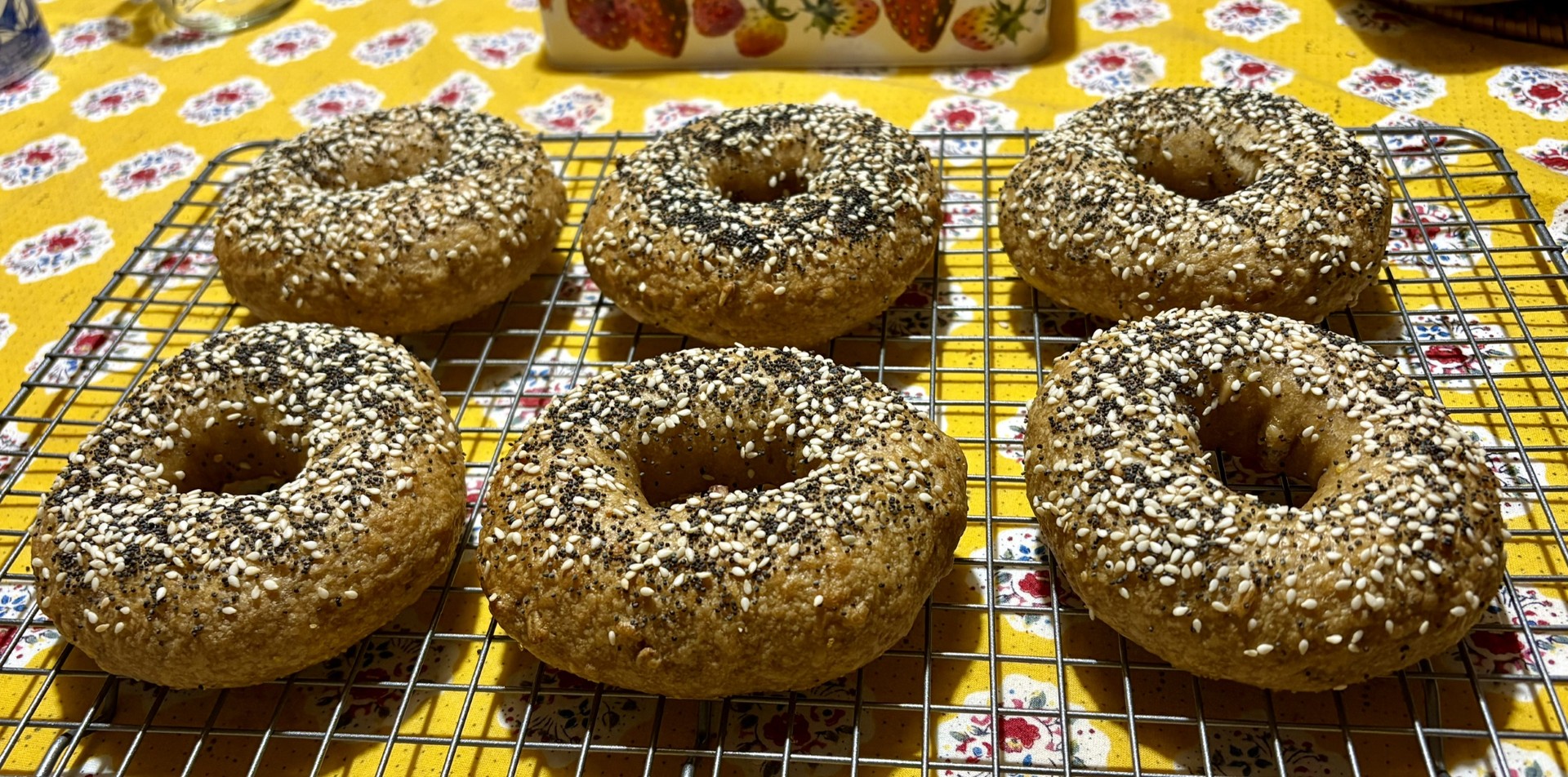
My third version of whole wheat and honey bagels with harvest grains. It took me two tries to get the flavor where I wanted it (sweet enough to enhance the whole grains but not too sweet). I felt my last try was a bit under-proofed (there was a little cracking on top and the not much oven spring). After getting some guidance from Jesse Szewczyk’s Bon Appetit podcast on bagels (thanks to @ChristinaM for pointing that one out), I gave this batch a little longer proof on the counter before the overnight retard. I also gave it a few seconds longer on the boil, which Jesse says can help mitigate under-proofing issues.
I def saw results from both these adjustments – a better final shape and no cracking. I might give it just a few more minutes on the counter next time before the overnight to gauge the results.
9 Likes
That photo is making me hungry.
2 Likes
Me, too! 4:00 AM is bagel baking hour at my house, and it’s still a few hours ‘til breakfast. 
I think most people don’t realize that the best way to eat NYC-quality bagels outside of NYC is to bake them in their own kitchen.
Those look wonderful!
2 Likes
I use the tartine recipe, so it’s a tablespoon of starter. I do leave my starter on the kitchen counter for 24-48 hours after peak. works for both pizza and bread, I haven’t noticed a change in dough quality.
best,
1 Like
Thank you! Of the several versions I have developed recently, these whole wheat bagels are my second favorite (right behind Garlic & Onion with Everythang).
Can you recommend a good starting recipe for someone who has never ventured into bagel territory before? (I’m kind of scared of the boiling pot of lye part…)
I wouldn’t even think of using lye. It’s one of the many hotly debated aspects of bagel making, but you can get a fine bagel boiling in plain water, or by adding barley malt syrup and/or adding baking soda.
Peter Reinhart’s recipe from Bread Baker’s Apprentice is, I think, a classic jumping off point for people wanting to delve into bagels. King Arthur has some very basic bagel recipes which also are useful for becoming familiar with the process, the science, and the variables.
I took a live-streaming class from King Arthur just this morning. It was a good intro-level course into bagels (even if I don’t follow or agree with some of their recommended practices). Here’s a photo of a few sample bagels from that class (the rest I’m giving an overnight ferment in the fridge and will boil and bake tomorrow). Mixed in a stand mixer, for a 2-hour bagel these were pretty tasty. I did have trouble with the rope-method of shaping them, and I’ll probably stick with the ball-and-punch. I’ll be curious to see how the dough differs in flavor and texture with the overnight ferment.
Like pizza dough and sourdough, the variables to bagel making are many and mostly subjective. Skimming through r/Bagels on reddit will give one plenty of things to consider when ultimately deciding what level of chew and % of hydration one prefers, and whether to use a poolish, preferment, or none.

5 Likes
I’ve never used lye in bagels. Always baking soda and barlely malt syrup in the boil water.
I use lye for pretzels, and I very pointedly DO NOT BOIL the lye water. I add about a tablespoon of lye crystals (~20 g) to a quart (~500 ml) of VERY cold water. Lye + water is exothermic. The water will heat up as the lye dissolves. Pretzels get about 10 seconds per side in this and come out VERY dark brown.
Bagels get baking soda and barley malt syrup, and get BOILED for about 20-30 sec. on each side.
Do some bagel makers use lye generally? Given the essential point of boiling in bagels. I would guess it would have to be a much weaker solution.
2 Likes
I just googled and yes, that seems to be the consensus. Lots of threads of people debating the merits of lye vs baking soda vs washing soda. Guess I’ll have to give this a shot sometime soon.
2 Likes
If you want a stronger (more alkaline) solution w/o resorting to lye, there’s always baked baking soda. Empty a box onto a rimmed baking sheet and spread it out, and place in an oven at 300F for 90-120 minutes, giving it a gentle stir every 15-20 min.
It will lose about 1/3 its weight and will now be Na2CO3 (pH between 11-12), rather than NaHCO3 (pH between 8.0-8.6). Not as strong as lye (pH between 13-14) but effective for pretzels if you don’t have or aren’t up to using lye directly.
3 Likes
I found it interesting that the King Arthur guys recommended no baking soda at all. No baking soda??? In my world, it’s a given (along with the barley malt syrup) for boiling bagels.
1 Like
Your personal idea (or ideal) of a bagel will factor in (see Kenji’s bagel manifesto below; I disagree that toasting is an equalizer – a bad bagel won’t become a good bagel by toasting, it just becomes toast).
Alexandra has an easy starter recipe. And Serious Eats has a good troubleshooting guide. SE also has a few different recipes – eg Stella Parks incorporates yudane, which is not classic, but keeps them fresh longer without freezing (I use tangzhong, similar idea but easier when not using a stand mixer).
I use malt (or molasses if malt isn’t available) in the boiling water and a bit in the dough too. No baking powder. And rest them in the fridge at least overnight, if not longer.
Finally, if you’re making bagels, also make deli-style cream cheese (preferably scallion) – it’s easy, and so worth it.
https://www.seriouseats.com/what-makes-a-good-bagel-bad-bagel-kenji-opinion-untoasted
3 Likes
Here’s Day 2 of the King Arthur Recipe (from class) after an overnight ferment. Interesting to see the seam on the rope disappear, and I got blisters which (expectedly) were not a characteristic yesterday.

9 Likes
No question. The most transcendent of bagel experiences I’ve had involved very recently baked bagels – still warm – with a perfectly just-crispy crust and chewy interior. Toasting can’t possibly bring this into existence; at best it can turn a formerly-great bagel into a shadow of its prior self.
2 Likes
My home is a house divided when it comes to toasting. DH is an “always toast” kinda guy, and I am a “toast only once the bagel has left the transcendental zone” kinda gal.
My take on Kenji’s “equalizer” comment is that toasting will make a transcendental bagel less-so, and a stale bagel more-than, bringing them both closer to being on equal footing (but not necessarily equal).
4 Likes
IMHO any bread product (or at least, any that I can think of off hand) is best within an hour or two of freshly baked, still at least a little warm from the oven. Cool to the touch but still within a few hours and thus “oven crisp” is also excellent.
Later that evening or any day afterwards, toast.
3 Likes
I am a toasted bagel person, I will toast even a freshly baked bagel.
I think this may be why the bagel setting on toasters toasts only one side.
If I’m toasting a previously made bagel, I moisten the outside before toasting, which freshens everything up (same as with a baguette).
2 Likes
I’ll beg to differ on this point when it comes to more rustic breads. I think they’re better after the proteins get a chance to fully set and attain some chewiness. They come off a touch mushy at first, for me. Of course there’s nothing quite like ripping open a steaming loaf just out of the oven, especially if butter is involved…
3 Likes

