Apparently regularly eating yogurt can reduce the microplastics in the body
There are a number of studies, here’s one:
Apparently regularly eating yogurt can reduce the microplastics in the body
There are a number of studies, here’s one:
Interesting. They may make the gut barrier strong enough to let the plastics pass through instead of being absorbed.
Thanks for the article.
There’s the separate issue of many yogurts being sold in plastic containers where microplastics seep in (I think someone is being sued about this at the moment.
But there are brands in glass or paper-ish containers these days.
And I prefer homemade yogurt myself when I’m not being lazy (at my mom’s, yogurt is set twice a day because it sours very fast — and that’s not the prevailing cultural flavor preference).
Same. I’m trying out a new culture from Ivo’s bacillus bulgaricus. It has a nice flavour.
I’ve never purchased culture. What do you think it adds, vs using existing yogurt (or even a geeen chilli top in a pinch  )
)
The flavour and texture is much better than any store bought yogurt. I also control the source of the milk by choosing a small, local dairy that pasteurizes the milk, but doesn’t homogenize it. I have found that unhomogenized milk tastes better and has a nicer mouthfeel. A culture also adds reliability to flavour, texture and time fermented. I will use already made yogurt to make a fresh batch, but there’s a time window for it to perform well. Some weeks we eat a lot of yogurt, so the bacteria gets used for new yogurt within a few days. Other times it doesn’t go as quickly, so I use a culture for a good result. I’ve been very happy with Ivo’s products and also make sour cream and creme fraiche quite regularly with those specific cultures.
The green chilli top is something I’ve never tried. Does it just curdle the milk or does it add its own bacteria?
Interesting. I grew up in twice-a-day yogurt culture —set in the morning for lunch, set after lunch for anyone who might eat some again or just for backup (usually yogurt is not eaten in the evening for various reasons).
So the same culture is propagated forward forever — or until someone forgot to save a bit of yogurt from the current batch and cleaned out the bowl  .
.
When someone returns from travel and forgot to save some of their culture in the freezer, it’s common to ask a neighbor for starter (no one goes to a neighbor for a cup of sugar — it’s either a bit of milk for a cup of tea, or a spoon of yogurt ). The only setting issues we have had are from someone else’s culture — it might take a couple of days to straighten out.
For myself, I will use whatever culture I was eating when I got lazy about making it myself — plain, organic, whole milk yogurt and sometimes kefir too.
Re green chilli — the stem is a source of natural lactobacillus. I had to test it out when I read about it, and it was pretty amazing to get perfect yogurt from a chilli stem. I do have a very sensitive palate, though, so I could taste a tinge of something in the first bowl (others didn’t), but it wasn’t in the second bowl using that culture.
I did buy some L Reuteri when a friend was on the 36h yogurt kick, but I haven’t tried it yet (mostly because I think 36h yogurt will be way too sour for me).
Making your own yogurt in Canada is still not very common and you really need to read labels on commercial brands to make sure you’re just getting milk and bacterial culture. If you would like to ask for some yogurt from a neighbour, it’s most likely flavoured, not something you’d want to start a batch with. You’re lucky to have grown up in a culture where good yogurt is such a staple.
I’ll have to try the chilli method, just for the sake of doing it.  Too curious for my own good to leave that one.
The L. Reuteri blend I have incubates in the yogurt maker for about 6 hours, but I have forgotten and left it in for over 12 and it has still been good and quite mild.
I’ll have to see if I can find it again but some years ago I posted study results where they made curd from Pasteurized/non, plus homogenized and not homogenized.
The slowest and lowest temp Pasteurization coupled with non-homogenized were by far the creamiest curd, with the high-temp fastest Pasteurization and homogenized being the grainiest and least appealing. I can’t remember how they characterized the protein structures but I believe that (changes to protein structure) was the main driver in the differences.
I also note that when I first started making paneer and needed to look for instruction, everyone said avoid the UHT Pasteurized milk/cream.
I just boil whatever milk I’m using again and let it cool down.
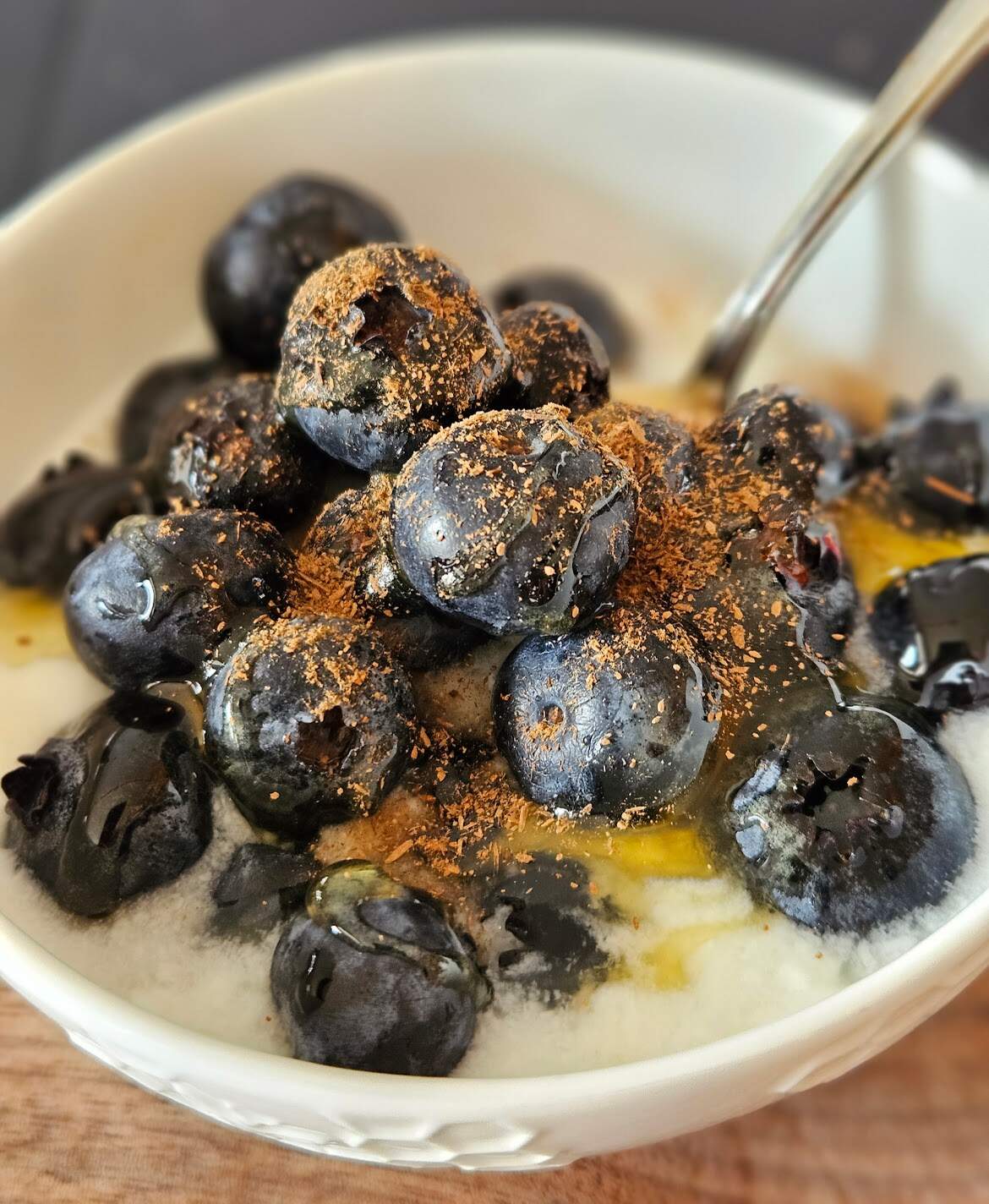
Part of today’s lunch: homemade L. reuteri blend yogurt with organic blueberries, Ceylon cinnamon and a drizzle of local honey.
I think this is true for all fermented foods.
Kimchi, kefir and kombucha probably have a more pronounced effect than yogurt.
Yes, the article in the OP is titled “probiotic or yogurt consumption”