Bogman, I noticed that on your SeedSavers Exchange post, you mention that “No C. annuum was grown nearby, so these seeds should be very pure.” I plan to grow Prik Kee Noo (Thai chili) next year and was wondering if cross polination will change the characteristics of the final fruit? If yes, is there a recommended seperation distance between different types of peppers so as to keep them “pure”?
" to lower the heat"
Your are right on there, the Septa/Veins is where the bulk of the Capsaicin resides not the Seeds as many believe.
Also the Er Jing Tiao are beautiful.
I’m not @bogman , but in general, cross pollination should only change the characteristics of the next generation of fruit. It changes the fruit you get if you plant the seeds of the fruit that develops from the flower that was cross pollinated.
Hope I didn’t make it more confusing!
Yes shrinkrap, I wasn’t clear enough in my post. I was thinking about the next generation of fruit from the seeds that might be cross polinated.
The more I thought about it and investigated it, I was thinking that it might not be a bad thing to have spicier Er Jing Tiao peppers (being cross polinated with Prik Kee Noo) and more flavorful, and less spicey Prik Kee Noo after being cross polinated with Er Jing Tiao… hmmmm???
1 Like
I see. I don’t know the growing distance but I know lots of folks recommend bagging the flowers.
Welcome to the group!
When cross pollination happens with peppers, the fruit/pods should not be affected. Crossing happens inside the seeds. If you save seeds, then the hybrids may show up the following generation(s).
Although sources are all over the map suggesting distances between different varieties to get pure seed, the truth is that it depends on what pollinators are present. Even if spaced 100 feet apart, some bees can/ will easily fly that distance. The Prik Kee Noo and Er Jing Tiao are both Capsicum annuum, making hybridization or outcrossing quite likely if the plants are grown near each other. To get pure pepper seed, you basically have three choices:
- Separate potential crosses by growing one of each incompatible species per year*. (*C. chinense & C, baccatum can cross, but not as vigorously). C, pubescens is unlikely to cross with others. C. frutescens crosses with several species.)
- Separate the plants by a distance of at least 1,000 feet or more.
- Bag unopened flowers, branches or entire plants to exclude pollinators. The best method is to use hoops and insect-proof netting to surround a group of the same variety, the entire plants. Open up the netting on one species at a time, e.g. variety #1 gets opened up so pollinators can pollinate WITHIN the variety for a few days. Then, close everything for a day or two before opening just variety #2 for a few days. Continue this as needed. This allows genetic exchange within the variety and increases yields of pods and seeds.
Some folks make “cages” out of wood framing, covered with screening, to cover individual plants. The cages can be lifted, one at a time, to the same effect as above. Bagging is more tedious, but uses less insect-proof material. It also reduces seed yields in most cases, unless manual pollination between the same variety is performed, more tedium.
Any crossing of Er Jing Tiao with Prik Kee Noo would be obvious, given the very different parent sizes.
3 Likes
I think I may give this method a try as I want to make chili oil and need both types of peppers.
Thank you very much for your detailed response !!!
1 Like
Great answer! Thank you!
Could you… ahem…mingle the flowers of the ones you wanted to cross, bagging the flowers before and after?
Yes, indeed. To get the best results, it’s best to remove the stamens before they release pollen on the female/seed-bearing flower. This is to minimize self-pollination. A #2 watercolor paint brush works well for pollen transfer.
1 Like
The first use of Er Jing Tiao, Fermented Black Bean Chili oil.
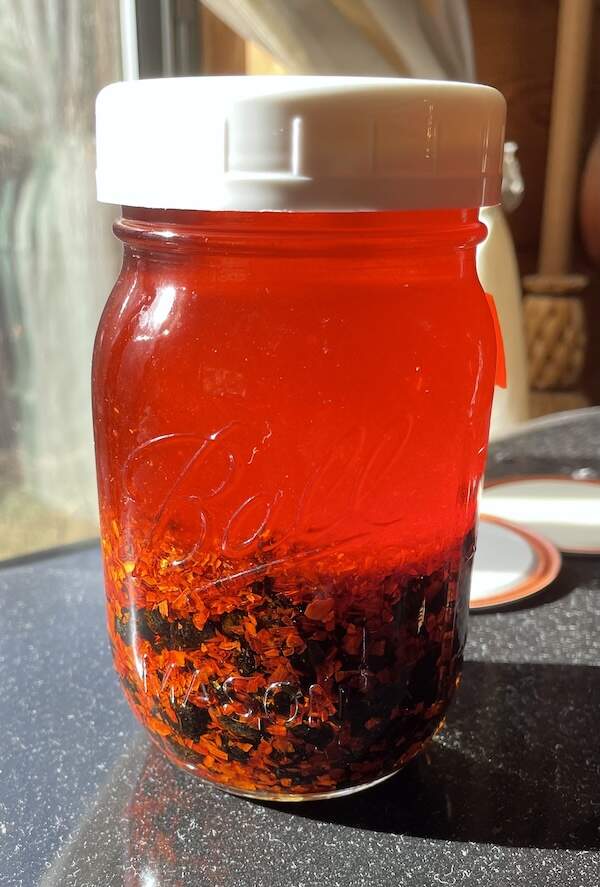
After removing seeds and the main septum, leaving some septa for heat, the chilies got flaked in a food processor. Fermented black beans and the flakes were put into very hot oil to sizzle and infuse. It’ll be ready in a few days, but I tried some out and it’s delicious, spicy, but not too much.
I’ve made this oil many times, tweaking the pepper mixture and recipe. This time, instead of mixing dried chilies, I used only Er Jing Tiao and am happy for it. Good color right after making, but it’ll likely get deeper as it ages. It’s umami-rich, with the flavor of toasted chilies.
7 Likes
Beautiful !!! I’m jealous.
Same question;
Can you walk me through your thinking about when to start seeds? How long to sprout in ideal conditions? What should the weather be like when you plant them out?
I usually start my seeds indoors by placing them on a damp paper towel which I place inside a plastic bag to keep the moisture in the towel from evaporating. Good seeds will sprout in under a week, after which I transfer the sprouted seeds to small sterile starter trays (fill with soil, poke a hole with a pencil, gently insert sprout, lightly compact soil). Then I place the trays under a full spectrum LED grow light (20 hrs of light per day), 4-6 weeks before the last frost in my area (May 1st for me). After 2-3 weeks inside, I move them outside to acclimate them to cooler temperatures and harden them to the wind. If the temp is predicted to go below 45 degF or extremely windy, I bring them inside – mostly at night because of the temperature. I plant them in the garden around the date of the last frost depending on the weather forcast – plant earlier if predicted to be warm, plant later if predicted to be cold.
Couple of questions:
- Do you transplant the seedlings from the small trays to anything bigger during the 4-6 weeks?
- Do you use a heater of any kind?
My experience with starting peppers in particular has been pretty bad and I think part of it is the fact that we keep our house pretty cool during the winter. (56F as I type this.) The seeds do great at first, when they’re sitting on warming mats with domes, and then as soon as I take that stuff away they just sit there for weeks seemingly doing nothing.
Thank you!
Are you describing pepper seeds in general, or species Capsicum annuum?
I found the annums much easier to sprout than the chinenses or even baccatum, but I wasn’t sure about these. I just read that they are annum.
Also, how would you describe your climate?
Frost is not much of an issue here, except for some nights in January, but nights stay cool for a long time, which effects planting out some peppers for me, and also I wasn’t sure how sensitive these peppers pollination was to heat.
It gets really hot (sometimes 90+ f ) by May here, but nights aren’t above 50 until around then, and it helps me to know which is more important. For some I grow I want them to be flowering by May first, but it can be problem if nights are still below 50, or if they are very big by then.
I think @bogman is starting his Madre Vieja peppers (baccatum) in February, but his climate is different from mine.
Here’s some chinenses and baccatum I am overwintering in a green house, but I still have a pubescens plant outside
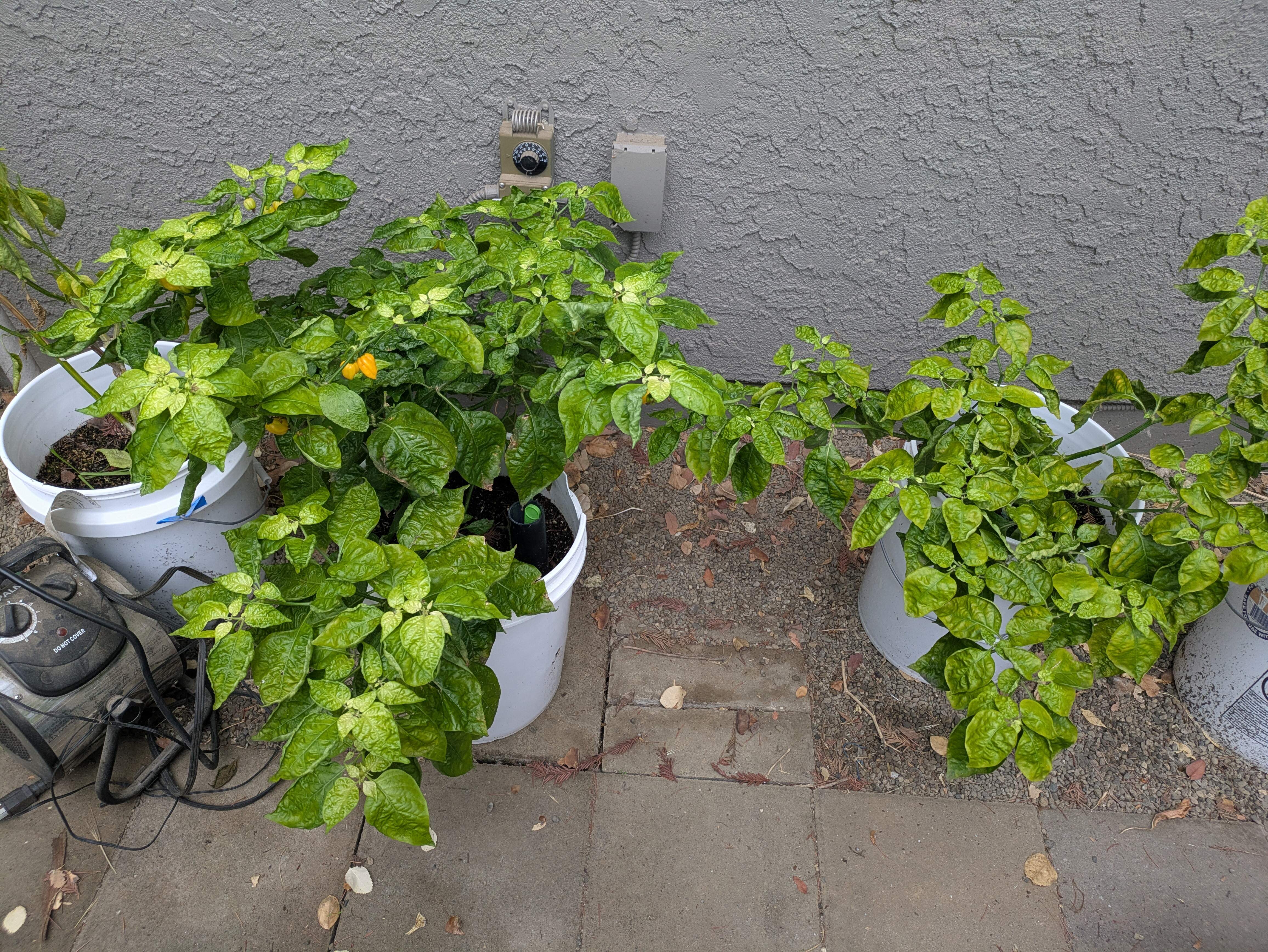


Yes, I typically go from a starter tray to a 4" pot in the 4-6 week period.
No I don’t use a heating pad; we keep our house at 73 degF during the day and 68 degF at night.
The climate here is classified as: humid subtropical with four distinct seasons. Our summer (June–August) is warm and muggy, with average highs reaching up to 88°F in July. We often have highs above or around 95°F. The humidity here can be very high and the peppers seem to love it.
We’re in hardiness zone 7 → last predicted frost typically end of Apr-early May.
Flowering is primarily influenced by maturity, temperature, light intensity, and nutrition. If you want them to be flowering by May I would start the seeds 4-6 weeks earlier so your plant is much larger/more mature by May. February might be the right choice as you mentioned above. Obviously additional transplanting will be required as well as proper temperature, light, and nutrition until such time that the weather outside is acceptable.
Once in the ground and “mature”, my pepper plants will continue to flower and fruit until we get a couple hard frosts. Not sure how 50°F nights will effect newer plants’ flowering – gut feel is that shouldn’t be a problem.
1 Like
My starting methods are a bit different from most because I’m growing quantities. Seeds are sown in row cell trays, trays with pre-cast furrows.
For peppers and the Virginia/mid Atlantic climate, the seeds are started in February, on heat mats set to 85°F (29°C). In the row cells, seeds are sown about 1/2 inch apart. An LED plant light is turned on once the first signs of sprouting occurs. More seeds are sown than will be needed, so the strongest can be chosen.
Once the cotyledons are fully-formed and the seedlings easy to handle, they are replanted into 125 cell trays, each cell about an inch (2.5cm) square. Fertilizer is applied about once a week, using a soluble type.
When the roots have filled those cells, there’s usually a couple regular leaves maturing. At that point the seedlings are poked out of their cells using a pencil, pressing through the drain hole. Transplants then go into 2 1/2- 3 inch (6.4–7.6cm), deep pots. Plants are still under strong LED light.
Once the soils warms to about 60°F (16°C), and the days are warm, trays of pots are placed outside to harden off. For the first few days, seedlings are exposed to full sun for only a few hours, preferably morning sun. You want to avoid sunburn. If the LED light is very strong and well-balanced in spectra (including UV and infrared), sunburn is less likely and the seedlings can be kept in full sun for longer. Watch the seedlings for signs of stress and move them into shade is they start to wilt.
After about a week, the plants can be set in the garden. For Er Jing Tiao, as stated before, it’s very important to remove all flowers until the plants are at least a foot high (30cm). This variety tries to flower and set pods way too early for its own good.
2 Likes
Thank you both for the detailed answers!
Not sure how 50°F nights will effect newer plants’ flowering – gut feel is that shouldn’t be a problem.
@blurt1962 I think the warnings I read about nights above 50-55 are because daytime temps+ nighttime temps effect soil temp.
pepper, like tomatoes, are a warm weather crop. They will not thrive until the soil and air are warm. Here in NY I dont usually put oout til late May - if you want them to progress earlier, you could put under some kind of dome.

